The input data comes in the form of a two dimensional table where
each row represents one trip.
For each trip, the table lists four columns with information about this trip:
start time, measured in minutes after midnight,
duration, measured in minutes, initial depot and final depot.
We have used data that reflect the operational environment of two bus lines,
Line 2222 and Line 3803, that serve a major metropolitan area.
Line 2222 has 125 trips and one depot and Line 3803 has 246 trips and two depots.
The input data tables for these lines are called OS 2222 and OS 3803, respectively.
By considering initial segments taken from these two tables,
we derived several other smaller problem instances.
For example, taking the first 30 trips of OS 2222 gave us a new
30-trip problem instance.
Table 1(a) shows the first 10 rows of OS 3803.
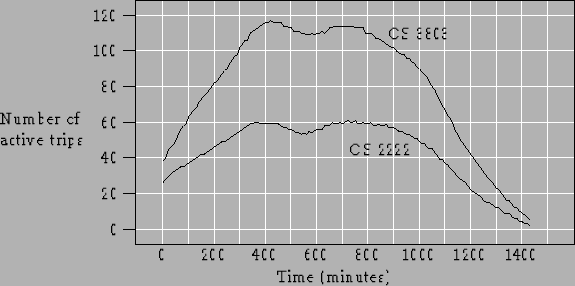
A measure of the number of active trips along a typical day, for both
Line 2222 and Line 3803,
is shown in Table 1(b).
Table 1:
(a) Sample from OS 3803 (b) Distribution of trips along the day
(a)
Start
Dur
I. dep.
F. dep.
1
38
1
2
50
40
2
1
90
38
1
2
130
38
2
1
170
38
1
2
210
38
2
1
250
39
1
2
290
38
2
1
285
45
1
2
335
45
2
1
(b)
This graphic was constructed as follows.
For each (x,y) entry, we consider a time window
.
The ordinate y indicates how many trips there are with start time
s and duration d
such that
or .
The particular shapes of these two curves represent a typical
daily workload in the operation of an urban bus company in Brazil.


![$T=[x,x+\emph{Workday}]$](img4.gif) .
The ordinate y indicates how many trips there are with start time
s and duration d
such that
.
The ordinate y indicates how many trips there are with start time
s and duration d
such that  or
or  .
The particular shapes of these two curves represent a typical
daily workload in the operation of an urban bus company in Brazil.
.
The particular shapes of these two curves represent a typical
daily workload in the operation of an urban bus company in Brazil.