




 ;
;
 ;
and
;
and
 ,
,
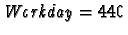 ,
,
 and
and
 ,
measured in minutes.
A duty which satisfies all problem constraints is called a
feasible duty. Any set of feasible duties constitutes a
schedule and for a schedule to be acceptable it must
partition the set of trips.
The cost of a schedule is the sum of the costs of all its duties.
As we are interested in minimizing the number of crews needed to
operate the bus line, all duties are treated equally and their costs
are set to one.
With this assumption, minimizing the cost of a schedule reduces
to minimizing the number duties (crews) in the solution.
Finally, a minimal schedule is any acceptable schedule with
minimum cost.
,
measured in minutes.
A duty which satisfies all problem constraints is called a
feasible duty. Any set of feasible duties constitutes a
schedule and for a schedule to be acceptable it must
partition the set of trips.
The cost of a schedule is the sum of the costs of all its duties.
As we are interested in minimizing the number of crews needed to
operate the bus line, all duties are treated equally and their costs
are set to one.
With this assumption, minimizing the cost of a schedule reduces
to minimizing the number duties (crews) in the solution.
Finally, a minimal schedule is any acceptable schedule with
minimum cost.