Regarding the select query, in the first set of experiments for each queried
window the blocks, where the queried features were found, were searched.
The results can be seen in Figures ![[*]](cross_ref_motif.gif) , and .
As observed before, the methods where the new
bitstring is embedded always perform much better than the respective ones
without the bitstring since we can avoid to visit tree branches where the
queried features do not exist.
, and .
As observed before, the methods where the new
bitstring is embedded always perform much better than the respective ones
without the bitstring since we can avoid to visit tree branches where the
queried features do not exist.
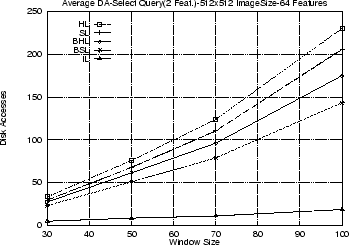
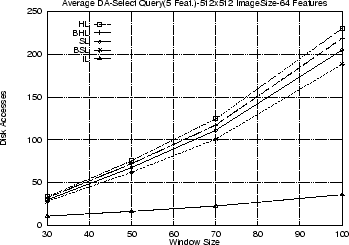
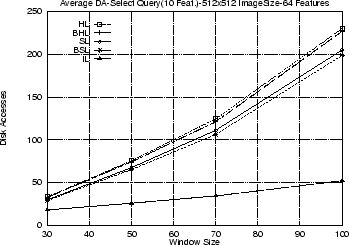
More specifically, in Figures , and
where we search for 2, 5 and 10 features respectively, it can be observed that
the IL-trees seem to have a good performance in comparison to the other methods.
However, their performance is not stable since it will always
depend on the number of queried features (as demonstarted in Figure
where all features are queried).
The explanation is that the IL-trees' performance is tightly connected to
the number of features queried, as well as to their occurrence frequency.
More specifically, sparse features with low occurrence will create very
small trees, possibly of even one node only, while the tree of a more
frequent feature will be bigger and will affect the method's performance
substantially.
In general, the IL-trees seem to work very well for a few features only,
which are rarely met in the thematic map.
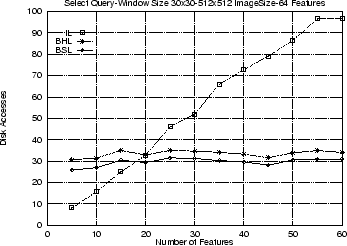
In the previous graphs, it is shown that with an increasing number of queried features, the performance of the IL-trees becomes worse and this tendency is apparent in the second set of experiments. In this second set of experiments, the methods' performance was tested for two fixed window sizes, where the number of the queried features was increasing.
As can be seen in Figure , the performance of the IL-trees
decreases progressively with the number of queried features resulting in a
quite bad performance when a large number of features is queried, whereas
on the contrary the BHL- and BSL-tree show a comparatively stable behavior.
As expected, on one hand SL- and BSL-trees, and on the other hand HL- and
BHL-trees behave similarly when a large number of features is queried and
that is why the graphs of the BSL- and BHL-tree only are shown.
As a conclusion, the previous experiments show that the technique of posting feature information by means of a bitstring to upper levels of a linear-type quadtree results in superior performance for:
 tree will be bigger.
Thus, filtering based on queried features can be applied at higher tree
levels and, thus, traversing some Btree branches can be avoided,
tree will be bigger.
Thus, filtering based on queried features can be applied at higher tree
levels and, thus, traversing some Btree branches can be avoided,
 |
 |
 |
 512, 64 features.