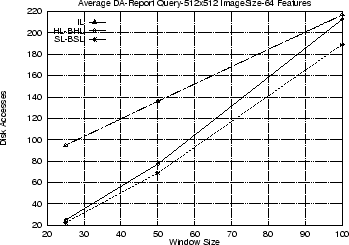
As described previously, the report query returns the features that exist
inside the queried window.
As far as the IL-trees are concerned, this means that for our data set, 64
indices should be visited to check whether the corresponding feature exists
inside the window.
This explains the reason why IL-trees have by far the worst performance, as
depicted in Figure ![[*]](cross_ref_motif.gif) .
The SL- and BSL-tree have exactly the same performance, since the bitstring
is not taken into any consideration.
The same applies for the case of HL- and the BHL-tree.
The BSL-tree is the best access method, while the slightly worse performance
of the BHL-tree can be explained by considering the larger number of leaves.
.
The SL- and BSL-tree have exactly the same performance, since the bitstring
is not taken into any consideration.
The same applies for the case of HL- and the BHL-tree.
The BSL-tree is the best access method, while the slightly worse performance
of the BHL-tree can be explained by considering the larger number of leaves.
 512 size containing 64 features.