


As far as the exist query is concerned, the performance difference of each examined method can be seen clearly. For each queried window, the existence of a number of features was searched. More specifically, the focus was in finding out whether at least one of the queried features existed inside the queried window. As soon as one of them was met, processing stopped.
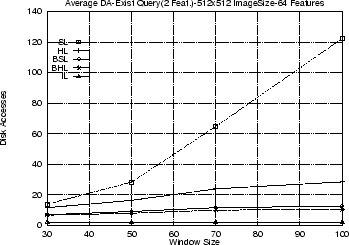
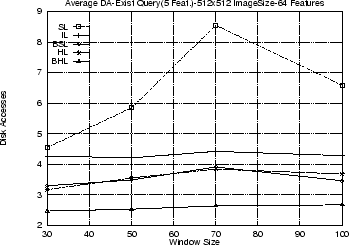
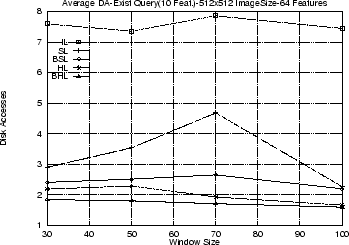
In Figures ![[*]](cross_ref_motif.gif) , , the results, when
2, 5 and 10 features are queried respectively, are illustrated.
A first observation is that the methods using the bitstring always perform
better than their counterparts which do not use a bitstring.
In addition, the BHL-tree outperforms all methods for more than 2 features.
This is explained by considering two facts:
, , the results, when
2, 5 and 10 features are queried respectively, are illustrated.
A first observation is that the methods using the bitstring always perform
better than their counterparts which do not use a bitstring.
In addition, the BHL-tree outperforms all methods for more than 2 features.
This is explained by considering two facts:
The bad performance of the SL-tree is explained by the fact that the specific
quadblocks of which, the region that is searched is comprised, have to be
found out in order to check the contained features.
As far as the IL-trees are concerned, all the feature-indices have to be
processed always without knowing whether the specific feature is contained
inside the queried window or not.
In addition, the order of accessing the independent indices is random and
there is no means to bypass non useful indices.
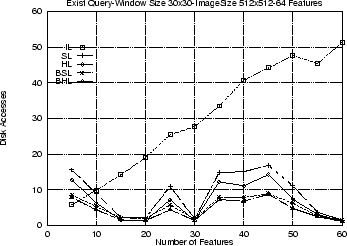
Figure depicts how the IL-trees' behavior worsens with respect to
the number of features.
 |
 |
 |
 |
 512, 64 features.