


Next: Conclusion
Up: Simulation of Imprecise Ordinary
Previous: Detailed Example: 1st-Order Imprecise
An electrical circuit (Fig.: 3) should be simulated.
Figure 3:
RLC Series Circuit
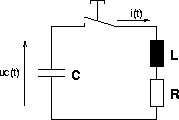 |
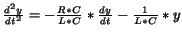
This circuit can be modelled by a 2nd order differential equation,
 .
Suppose the component values are imprecisely known (tolerances) and therefore
defined with
the fuzzy values
R=(50,40,40),
L=(1,0.1,0.1),
C=(0.001,0.0001,0.0001),
y(0)=(10,1,1), and
dy(0)=(0,0,0). The Runge-Kutta method uses
tstart=0 and tend=1 with a step size of 0.02.
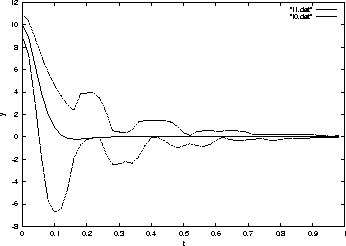
Fig. 4 shows the result of the simulation.
The solution of the simulation states the desired result.
When several solutions have
to be overlayed to get the overall solution space, the Interactive
Evolutionary Algorithm Approach
is jumping between these solutions back and forth saving the results in
the minimum/maximum database. When only one
solution of the differential equation represents the extreme boundaries,
the evolutionary algorithm does not alternate between solutions
and finds directly the optimum problem sets.
.
Suppose the component values are imprecisely known (tolerances) and therefore
defined with
the fuzzy values
R=(50,40,40),
L=(1,0.1,0.1),
C=(0.001,0.0001,0.0001),
y(0)=(10,1,1), and
dy(0)=(0,0,0). The Runge-Kutta method uses
tstart=0 and tend=1 with a step size of 0.02.
Fig. 4 shows the result of the simulation.
The solution of the simulation states the desired result.
When several solutions have
to be overlayed to get the overall solution space, the Interactive
Evolutionary Algorithm Approach
is jumping between these solutions back and forth saving the results in
the minimum/maximum database. When only one
solution of the differential equation represents the extreme boundaries,
the evolutionary algorithm does not alternate between solutions
and finds directly the optimum problem sets.
Figure:
Result of:
 |
Christoph Reich
1999-12-22