-cut level sets,
can be formulated as searching for an overall minimum
and an overall maximum curve at each
-cut level.
Finding a set of initial values and differential
equation parameters which represent either the maximum or the
minimum of a solution space is impossible, because there exists no such set.
An infinite number of problem sets might be necessary to represent
the solution space of a differential equation.
-cut level sets,
can be formulated as searching for an overall minimum
and an overall maximum curve at each
-cut level.
Finding a set of initial values and differential
equation parameters which represent either the maximum or the
minimum of a solution space is impossible, because there exists no such set.
An infinite number of problem sets might be necessary to represent
the solution space of a differential equation.
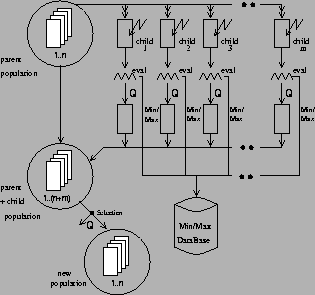
The Interactive Evolutionary Algorithm Approach is based on the classical evolutionary algorithm first described by I. Rechenberg [5], [6], and H.P. Schwefel [8]. This model of the evolution is suitable for optimization problems in general, but is not directly suitable for simulating an imprecise ordinary differential equation. The algorithm is called interactive because the objective function assumes that the fuzzy values are interactive during the evaluation of the chromosomes.
One possibility to decode the problem by evolutionary algorithms is by expanding the chromosome to represent the problem set more then once, theoretically infinite size. Then the differential equation solutions represented by these sets build the overall minimum/maximum curve. The drawback of this approach is the increasing number of calculations necessary.
The Interactive Evolutionary Algorithm Approach runs each
-cut level and codes
the parameters and the initial values of the differential equation
just once by the chromosome.
For each chromosome the differential equation is simulated and
the solution space represented by y-t value pairs is stored in a database.
The first time
the empty database is filled with the first calculated y-t values.
Later the calculated values are saved
when they are smaller/bigger than the actual minimum/maximum value
stored in the database.
When no single problem set of initial values and differential
equation parameters exists, the Interactive
Evolutionary Algorithm Approach jumps from
one possible problem set to the other recording the
overall minimum/maximum value in the database.
Both the minimum and the maximum should be optimized. Therefore
the evolutionary process must run twice for every
-cut level.
Contrary to the classic evolutionary algorithm is the addition
of the database which records the
absolute minimum/maximum values of the evaluation process.