


As we mentioned before, the issue of exception handling in workflows is a growing area of concern and research within the workflow community. But such problem can be better addressed in this logic framework.
First it must be noticed that this logic framework is much more flexible than standard workflow languages. The process specification in the logic formalism usually does not preclude other activities form being performed. What is important is that the workcase be consistent with the process specification, and not a instance of it in the standard workflow semantics. Thus if a non planned meeting is needed, it can be called, provided it is consistent with process, constraints and policies. Under the logic framework, the specifications can be seen as an envelope that limits the range of variability of the workcase.
But exception handling may involve not only executing unplanned activities but violating some of the procedures, constraints, and policies. For example in a particular case it may be decided that in order to get the results in time one can call a meeting with less than three days of advance. This means that to deal with this exceptional case one is willing to go outside the bounds of the envelope set by the specifications.
The balance of control and flexibility for exception handling can be
modeled as a set of formulas
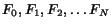 ,
which states
different levels of exceptionality. F0 is the process and policies
for normal (standard, unexceptional cases). F1 may represent the
process and policies for a first level of exceptionality, F2 for a
second level of exceptionality, and so on. FN represents the last
level of exceptionality, that is the processes, and policies that
cannot be violated in any case.
,
which states
different levels of exceptionality. F0 is the process and policies
for normal (standard, unexceptional cases). F1 may represent the
process and policies for a first level of exceptionality, F2 for a
second level of exceptionality, and so on. FN represents the last
level of exceptionality, that is the processes, and policies that
cannot be violated in any case.
A particular workcase wc may be declared or perceived as exceptional
and instead of following the standard process model F0, it may
follow F1. That is, we require that
 and not
 as we require for ``standard'' workcases. Of
course, to be able to deal with the exceptionality of the case, F1must be less constrained than F0, or in intuitive term, must be a
larger envelope than F0. In general one would ask that
as we require for ``standard'' workcases. Of
course, to be able to deal with the exceptionality of the case, F1must be less constrained than F0, or in intuitive term, must be a
larger envelope than F0. In general one would ask that
 ,
that is, that the set of policies and procedures for
the exceptional case be a ``logical'' subset of the standard set of
policies. In F1, some constraints that are required in F0 are no
longer required, such as the demand for a three day interval between
the call for a meeting and the meeting itself.
,
that is, that the set of policies and procedures for
the exceptional case be a ``logical'' subset of the standard set of
policies. In F1, some constraints that are required in F0 are no
longer required, such as the demand for a three day interval between
the call for a meeting and the meeting itself.
Similarly in general one would ask that
 ,
FN being the core of the organization's
policies. Thus different than other solutions to the problem of
flexibility of workflows, this logical solution allows for modeling
the constraints and policies to deal with different levels of
exceptionality: if a good customer requests urgency for an order, one
is allow to circumvent some of the standard procedures, if the best
customer requests urgency for an order more of the standard procedures
may be circumvented. But if parts or pieces of the procedures are
dictated by law and verified by government agencies, those pieces of
the process cannot be changed. In our terms, these ``pieces of the
procedure'' are subformulas that are stated in all process
specifications F0 to FN.
,
FN being the core of the organization's
policies. Thus different than other solutions to the problem of
flexibility of workflows, this logical solution allows for modeling
the constraints and policies to deal with different levels of
exceptionality: if a good customer requests urgency for an order, one
is allow to circumvent some of the standard procedures, if the best
customer requests urgency for an order more of the standard procedures
may be circumvented. But if parts or pieces of the procedures are
dictated by law and verified by government agencies, those pieces of
the process cannot be changed. In our terms, these ``pieces of the
procedure'' are subformulas that are stated in all process
specifications F0 to FN.