


The central concern of dynamic change is the fact that there was an
old ``process model'' Fo and now there is a new model Fn. The
case wc was assumed to be consistent with Fo up to time  ,
that is
,
that is
 .
The issue is whether the workcase is
consistent with the new model, and what should be the next activities
to be executed. In other words, one would like to discover whether
.
The issue is whether the workcase is
consistent with the new model, and what should be the next activities
to be executed. In other words, one would like to discover whether
 ,
and if so, determine the set of activities psuch that
,
and if so, determine the set of activities psuch that
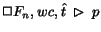 .
.
If indeed
and
then the
workcase can be ``transfered'' to the new process. We will say that
the change is safe for that workcase (at that time). If for all
workcases and for all times, the change is safe, we will say that the
change is everywhere safe. From the definition of logical
consequence, if a change is everywhere safe then
 |
(22) |
Of course it may be the case that the workcase is not consistent with
the new procedures Fn. The issue is what activities should be
performed in order to make the case consistent with the new
procedures. One possibility is that the case is left to follow the old
procedure for a while until a moment in the future in which it can be
``transfered'' to the new procedure. This can be modeled as, whether
there is (will be) a time
 such that


 ,
if an
activity that cannot be undone (like shipping the merchandise)
happened after t' that will not be taken into consideration under
this scheme. In this case a better approach would be to use the scheme
above: allow the case proceed in the Fo rules, possibly undoing
some of those activities, until it reaches a state from which it can
be transfered to Fn.
,
if an
activity that cannot be undone (like shipping the merchandise)
happened after t' that will not be taken into consideration under
this scheme. In this case a better approach would be to use the scheme
above: allow the case proceed in the Fo rules, possibly undoing
some of those activities, until it reaches a state from which it can
be transfered to Fn.
Although we could represent what was required for a case to be dynamically changed to a new procedure, in the case of an unsafe change we cannot yet determine if there are algorithms to determine when in the future (or in the past) could a case be transfered to the new procedure.