


Next: Significance of the Model's
Up: DESIGNING THE ROAD NETWORK
Previous: DESIGNING THE ROAD NETWORK
The Major Classes in the RNDM are divided into base
classes and concrete classes. A base class is an abstract
class that is used to represent a template for a geographic
object. It can't be instantiated. Typically, there will be
subclasses of it which will inherit it's properties down the
hierarchy. A concrete class, on the other hand, can be instantiated
with real world objects.
The base class is: GeoObject.
GeoObjects is a template for the geographic
objects in the model (See [1] for details).
Analysis of the requirement specifications of the shortest path
problem shows that most of the queries pertaining to the RNDM would
be asked with reference to certain well understood geographic objects
in the model, such as country, prefecture, or city. Prefecture, and
city etc., are the container geo-objects that contain other container
and non-container geo-objects. Roads and rivers are the examples of
non-container geo-objects. Thus the geographic objects in this
application can be broadly divided into container geo-objects which
contain
other geographic objects and non-container geo-objects which don't
contain any other geo-object. Due to this fact, the following two
abstract classes are defined:
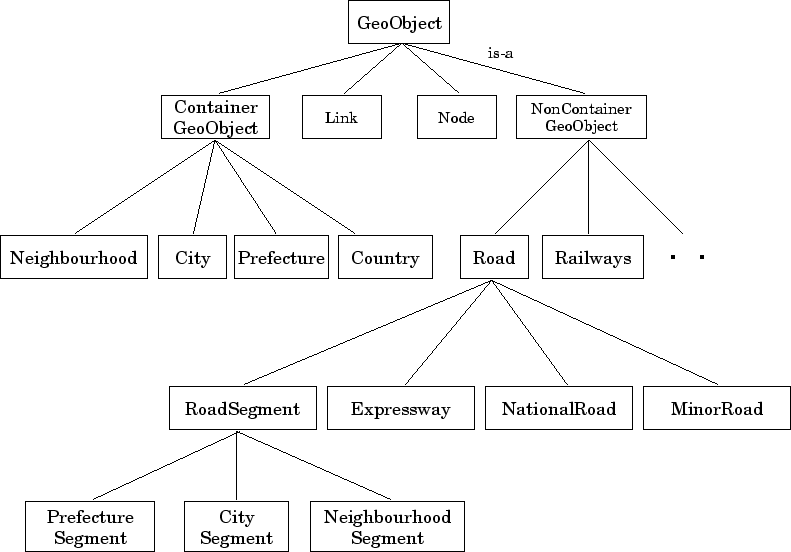
ContainerGeoObject class is defined to represent container
geo-objects in the model. In order to add real life container
geographic objects like country, prefecture, and city in the model
|mboxconcrete subclasses Country, Prefecture, City, and
Neighbourhood of
the subclass ContainerGeoObject are defined.
NonContainerGeoObject class is defined to represent the
non-container objects in the model.
The class Road is an abstract subclass of the class
NonContainerGeoObject that is used as a template for road objects in
the model. In order to add real life road objects in the model
concrete subclasses, Expressway, CityExpressway, NationalRoad,
PrefectureRoad, CityRoad, and MinorRoad of the class Road have been
defined. We also define a concrete subclass RoadSegment of the
class Road. To add real life road segment we define three subclasses
PrefectureSegment, CitySegment, and NeighbourhoodSegment of the
class RoadSegment. The class hierarchy is shown in Figure 2.
The subclass Node represents cross point of two roads,
start/end point of
a road, or cross point of
boundary of a geographic object and road.
The subclass Link represents the part of the road from node
to node
in this model. To represent this a class Link has been defined. Link
in the road network data model may be a ramp, a bridge or a tunnel.
Figure 2:
Class hierarchy
 |
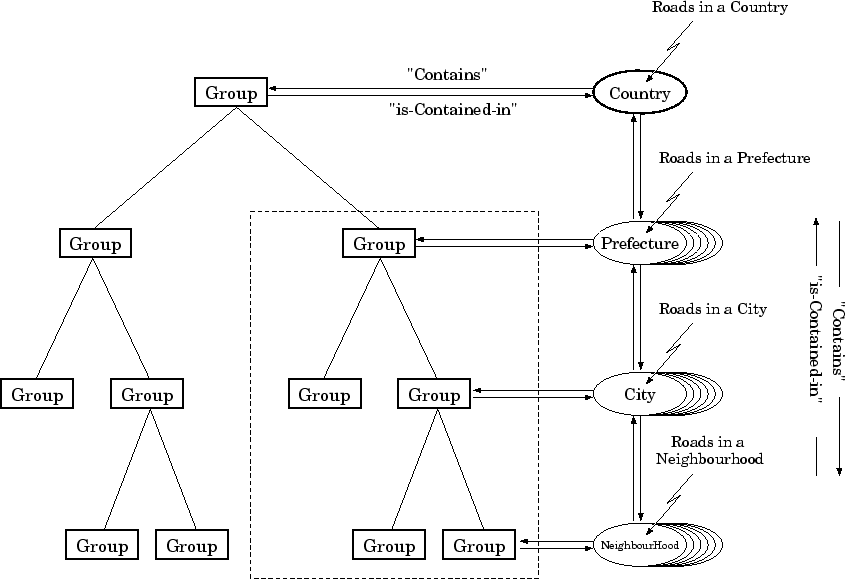
These geographic objects are arranged in a containment hierarchy with
country containing prefectures, expressways, city expressways and
national roads etc. And prefecture containing cities, prefecture roads,
and prefecture segments of expressways, city expressways, and
national roads. Similarly it can be explained down the heirarchy as
shown in Figure 3.
Due to the complexity of showing every thing in
one figure we used the word group. The group at country level
means the group of the prefecture segments of expressways, city
expressways, and national roads which make a road at country level. The
group at prefecture level means the group of city segments of each
road that makes a prefecture road or a prefecture segment of a road and
so on. At the lowest level the group consists of the links that
make the neighbourhood road or neighbourhood segment of any road.
Figure 3:
Containment hierarchy
 |
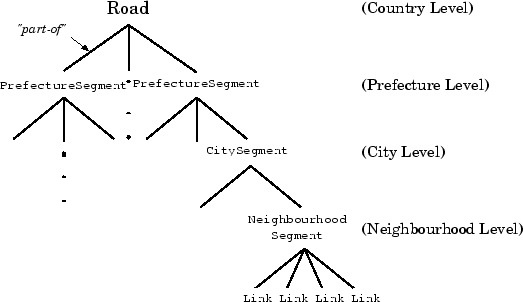
At this stage in the design process it is noticed that non-container
geo-objects can be divided into composite segments. For example,
non-container geo-object such as, expressway is composed of prefecture
segments of the expressway which are contained entirely by
prefectures. And similarly, prefecture segments and prefecture roads are
composed of city segments which are contained entirely by cities as
shown in Figure 4.
Figure 4:
Composite hierarchy of Road
 |
Next: Significance of the Model's
Up: DESIGNING THE ROAD NETWORK
Previous: DESIGNING THE ROAD NETWORK
M.Abaidullah ANWAR
1999-11-25