


Next: CONCLUSION
Up: OORF: AN OBJECT-ORIENTED ROUTE
Previous: EVALUATION
Shortest path problem has been an active area of research in
network theory over the past three decades. Many algorithms
have proposed. Their emphasis has been on using topographic and
geographic knowledge and reasoning to solve the problem. The major
concern in AI are spatial knowledge representation and
reasoning. [8] proposed a technique to use level
structure of the road network to help searching for a path
efficiently. This is similar to our minor and major road structure
and it can be extended to any number of levels. We will explain
inefficiency of this algorithm by an example. Let us suppose that
source and the destination nodes are on the minor roads. Then, the
algorithm proposed in [8] will search for shortest path
to a node  in the major road network from the
source node
in the major road network from the
source node  . It will then do again like this for the
destination node to find a node
. It will then do again like this for the
destination node to find a node  on the major road
network. Then it uses Dijkstra's algorithm for shortest path
between and in the major road
network.
on the major road
network. Then it uses Dijkstra's algorithm for shortest path
between and in the major road
network.
This technique minimizes the time travelling on minor roads and
also reduces the search space. However, the problem is that the
two nodes and could be on the
wrong major roads. Then the path found will not be shortest
path. Figure 5 explains this situation. The path searched by this
technique for source and destination  is:
is:
 . But, it is
clear form the figure that it is a longer path than the shortest
path
. But, it is
clear form the figure that it is a longer path than the shortest
path
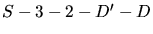 searched by our
technique. Therefore, it is not a good solution. Our approach
solved
this problem by using the minor and major road networks in the
source and the destination neighbourhood and only the major road
network in the container geo-object containing both the
neighbourhood. There is no chance of landing on wrong major
roads.
searched by our
technique. Therefore, it is not a good solution. Our approach
solved
this problem by using the minor and major road networks in the
source and the destination neighbourhood and only the major road
network in the container geo-object containing both the
neighbourhood. There is no chance of landing on wrong major
roads.
Another advantage of our approach is that it partitions the whole
network into smaller subnetworks contained in prefectures, cities
and neighbourhood. This is important for a large road network.
Another related AI-based system is proposed in [6]. In
this approach the major road network is not pruned off and
therefore, after deciding the grid sub-networks the shortest path
algorithm searches in all the major road network with minor road
networks in grid networks. But, in our approach we also prune off
the search space in major road network and give a substantially
reduced major road network to the shortest path algorithm for
search (see problem solving algorithm). This part of the major
road network may be in a city containing source and destination
neighbourhood or a prefecture or a country at the highest level.
Next: CONCLUSION
Up: OORF: AN OBJECT-ORIENTED ROUTE
Previous: EVALUATION
M.Abaidullah ANWAR
1999-11-25