


We will define that a model m1 is a compression of a model m2after time  ,
represented as
,
represented as
 if:
if:
 .
.
 ,
,
 if and only if
 and
if
and
if
 then
then
 if they agree in everything up to time t, and after time
all activities in m1 start before (or at the same time) as
the activities in m2.
if they agree in everything up to time t, and after time
all activities in m1 start before (or at the same time) as
the activities in m2.
The relation
 is reflective, transitive, and antisymmetric.
We will say that a model m' is minimal (in relation to
)
in a set M if there is no other model in M that is a
compression of m' and that is not m' itself.
Let us call X the set of all minimal models of all continuations of
the workcase, after the current time ,
that are consistent with
F. The activities that can start immediately after time ,
are
the activities
is reflective, transitive, and antisymmetric.
We will say that a model m' is minimal (in relation to
)
in a set M if there is no other model in M that is a
compression of m' and that is not m' itself.
Let us call X the set of all minimal models of all continuations of
the workcase, after the current time ,
that are consistent with
F. The activities that can start immediately after time ,
are
the activities  such that:
 |
(20) |
that are consistent with F, and for which the start of all
activities is anticipated as much as possible. If an activity p is
enabled, it means it could start in the next moment, and therefore, in
minimal models they will indeed start at the next moment. The method
of defining a partial order among models and selecting only the
minimal one is the essence of the preferential non-monotonic logics
[12].
We will denote the fact that for all
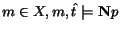 as
as
 |
(21) |
and the
procedures and policies  ,
p can start in the next moment.
,
p can start in the next moment.