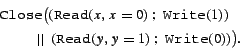
Here we present the semantics of an implementation-biased model
with distributed local dataspaces,
henceforth called the local semantics.
To formalize that in this model, read statements of different components might
observe the write events in different order,
we introduce a set
 of process identifiers
and extend the semantic primitives of the previous section.
In addition to the three fields
of process identifiers
and extend the semantic primitives of the previous section.
In addition to the three fields  ,
,
 and
and
 ,
we add a fourth
,
we add a fourth
 field, which is a function that
assigns a process identifier to each event in
.
This leads to so-called local semantic primitives (denoted
field, which is a function that
assigns a process identifier to each event in
.
This leads to so-called local semantic primitives (denoted
 ).
).
For simplicity, we restrict ourselves to so-called non-nested
Splice programs, denoted by  , where parallel composition
does not occur inside sequential composition.
In this way, we avoid a complex definition of
assigning pids to processes.
Consider, e.g., a program of the form
, where parallel composition
does not occur inside sequential composition.
In this way, we avoid a complex definition of
assigning pids to processes.
Consider, e.g., a program of the form
 . Here it is
unclear whether the pid of program
. Here it is
unclear whether the pid of program  should be equal to the pid
of
should be equal to the pid
of  ,
,  or none of them.
The semantics of a non-nested Splice program ,
given an initial state  ,
to a set of local semantic primitives, denoted
,
to a set of local semantic primitives, denoted
 ,
is obtained by adapting the semantics of the previous section as follows.
,
is obtained by adapting the semantics of the previous section as follows.
 ,
,
 and
and
 is basically equal to the global
semantics extended with a
field.
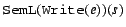
The value of this field is not restricted and may take any possible value,
e.g.:
is basically equal to the global
semantics extended with a
field.
The value of this field is not restricted and may take any possible value,
e.g.:

 .
.
 becomes more complex,
as explained below.
becomes more complex,
as explained below.
![\begin{eqnarray*}
& & \rule{-0.62cm}{0cm}\mbox{\tt {SemL}$($}{\tt Close}(S)\mbo...
... ~\wedge~\mbox{\it act}(E_1) = {\tt W}(d)]]\big]\big]\big]\big\}
\end{eqnarray*}](img88.gif)
 are assigned the same pid as in
(line 5) and that the main
difference with the semantics of the previous section concerns the
order on the events.
The requirement of a single, total order on all events
is replaced by two conditions:
are assigned the same pid as in
(line 5) and that the main
difference with the semantics of the previous section concerns the
order on the events.
The requirement of a single, total order on all events
is replaced by two conditions:
 on the read events
which extends
but does not order write events before others
(lines 6 to 9).
on the read events
which extends
but does not order write events before others
(lines 6 to 9).  there exists a local total order
  which extends (lines 10 and 11) and is such that each read
event with process
identifier has a preceding (w.r.t. ) write event with the
same value (lines 12 to 15). This local order allows write actions to be
ordered differently for each process, modelling the non-atomicity of
write actions. extending
.
Then the proof of equivalence in PVS failed and we found that the
definition was wrong.
Consider, for instance,
which extends (lines 10 and 11) and is such that each read
event with process
identifier has a preceding (w.r.t. ) write event with the
same value (lines 12 to 15). This local order allows write actions to be
ordered differently for each process, modelling the non-atomicity of
write actions. extending
.
Then the proof of equivalence in PVS failed and we found that the
definition was wrong.
Consider, for instance,